
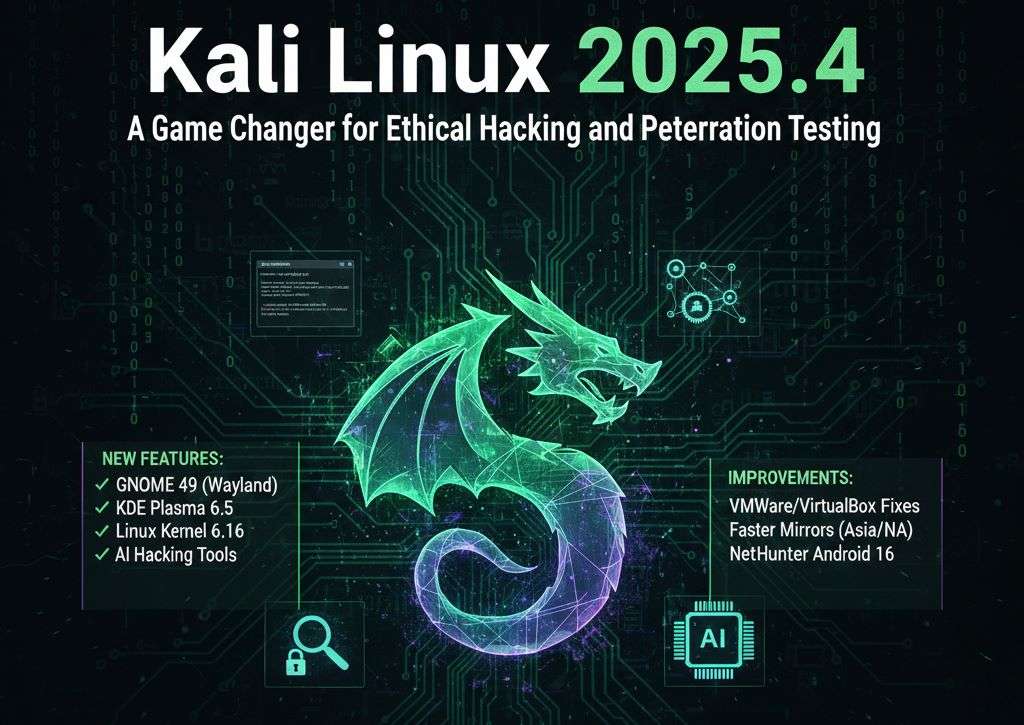
The world of cybersecurity is always evolving, and the tools used by ethical hackers and security professionals must keep pace. The release of Kali Linux 2025.4 marks a significant milestone, delivering a host of major upgrades that redefine the penetration testing platform. This update is not just a seasonal refresh; it’s a foundational overhaul focused on modernizing the user experience, enhancing tool accessibility, and ensuring seamless operation in complex environments.
Table of Contents
If you are a security researcher, a professional penetration tester, or simply learning ethical hacking, Kali Linux 2025.4 brings powerful new capabilities you cannot afford to ignore.

Desktop Evolution: GNOME 49 and KDE Plasma 6.5 Redefine Efficiency
The most visible changes in this release come through substantial updates to the primary desktop environments, promising superior performance and a more polished look.
The GNOME environment has been upgraded to GNOME 49, a monumental shift as it becomes entirely Wayland-only, dropping X11 session support. This transition is critical for modern desktop performance and security. Key enhancements include:
- The replacement of the aging Totem video player with Showtime, a modern GTK4-based application offering a clean, distraction-free viewing experience.
- Improved organization of Kali’s extensive toolkit, with the application grid now utilizing categorized folders that mirror the menu structure, making tool discovery dramatically easier.
- A long-requested terminal shortcut (Ctrl+Alt+T or Win+T) is finally here, streamlining workflow for veteran users.
Meanwhile, KDE Plasma 6.5 incorporates two major releases’ worth of improvements, focusing on user experience enhancements. Testers can now enjoy more flexible window tiling, a redesigned and more powerful screenshot tool, and quick access to pinned clipboard items. For those who frequently misspell commands, the addition of fuzzy matching support in KRunner is a minor feature with major time-saving potential.
For users of the lighter Xfce environment, Kali Linux 2025.4 achieves feature parity with its larger siblings by introducing comprehensive color theme support. Users can now fully customize colors for icons, GTK, and window decorations, giving Xfce the modern aesthetic control it previously lacked.

Seamless Virtualization with Complete Wayland Support
A crucial improvement for the cybersecurity community is the realization of complete Wayland support across all major Virtual Machines (VMs). Historically, virtualization platforms like VirtualBox, VMware, and QEMU struggled with certain Wayland features.
In Kali Linux 2025.4, the development team has ensured that features like clipboard sharing and window scaling work flawlessly, eliminating the compatibility concerns that once forced many penetration testers to stick with X11 in their virtualized labs. This pivotal change solidifies Wayland as the default and superior experience, even when running Kali as a guest OS.
The New Arsenal: Tools for Modern Penetration Testing
Kali Linux 2025.4 solidifies its reputation as the premier toolkit by integrating powerful new utilities designed for contemporary attack scenarios:
bpf-linker: A simple static linker for Berkeley Packet Filter (BPF) programs, essential for advanced eBPF-based security tooling.evil-winrm-py: A robust, Python-based implementation for executing commands on remote Windows machines via the Windows Remote Management (WinRM) protocol. This tool supports multiple authentication methods, including NTLM, Pass-the-Hash, and Kerberos, making it vital for enterprise network penetration testing.hexstrike-ai: A forward-looking addition, this MCP server enables AI agents to autonomously run security tools. This integration represents a significant, exciting step towards AI-assisted penetration testing workflows, allowing testers to explore automation like never before.
The release also upgrades the core operating system with the robust Linux kernel 6.16, bringing performance enhancements and critical infrastructure improvements.
Wireless Warfare and Global Reach
Beyond the desktop and core system, Kali Linux 2025.4 enhances mobile and wireless capabilities through NetHunter integration.
The powerful rogue access point framework, Wifipumpkin3, receives enhanced NetHunter support, making advanced wireless auditing—such as Evil Twin attacks, captive portal credential harvesting, and DNS spoofing—more accessible than ever. Furthermore, the Kali NetHunter project expands its support, now including extensive Android 16 support for popular devices like the Samsung Galaxy S10 family running LineageOS 23, complete with internal wireless injection capabilities.
In a move addressing its rapidly growing global availability, the Kali team has proactively expanded its mirror infrastructure. Cybersecurity professionals worldwide will benefit from faster download speeds, thanks to the addition of three new Asian mirrors (located in India and South Korea) and one additional North American mirror. This improved infrastructure ensures that the worldwide community of ethical hackers can access the latest updates quickly, regardless of their GEO location.
Conclusion
Kali Linux 2025.4 is a robust, forward-looking release that addresses key pain points in desktop environment modernization and virtualization while expanding its offensive arsenal with AI and specialized Windows hacking tools. For anyone serious about penetration testing and cybersecurity, this update provides the speed, stability, and advanced features required to stay ahead of the curve.
To start using this powerful new version, users can download the fresh images from the official Kali Linux website, or existing users can simply run the full-upgrade command to get all the latest updates, including the new Linux kernel 6.16.